Subterranean termite treatment requires specialized structural deployment along the Lowcountry coastal plain. Soil compositions in West Ashley, James Island, and Daniel Island contain high water tables that dilute…
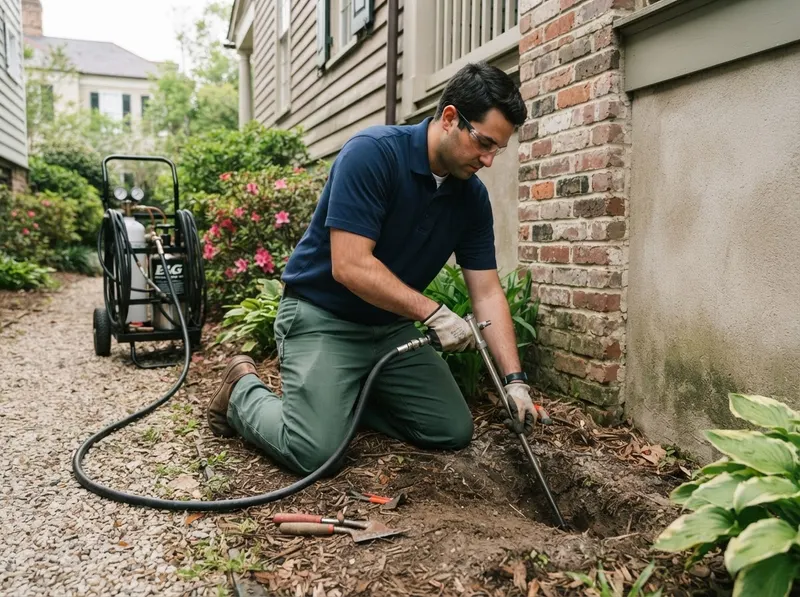
Subterranean termite treatment requires specialized structural deployment along the Lowcountry coastal plain. Soil compositions in West Ashley, James Island, and Daniel Island contain high water tables that dilute standard topical pesticides. Soil-directed treatments utilize non-repellent fipronil chemistries (typically mixed at a 0.06% to 0.125% active ingredient solution), which foraging worker termites pass through undetected, transferring the material through social grooming throughout the underground colony. In crawlspace homes across Wagener Terrace and Hampton Park Terrace, crawlspace soil relative humidity routinely exceeds 70%, creating optimal mud-tube pathways up brick piers and foundation sill plates. Technicians dig continuous four-by-four-inch trenches along both exterior foundation perimeters and interior foundation crawl walls, saturating the trench with four finished gallons of termiticide per ten linear feet per foot of depth.
Historic structures located Downtown Charleston / South of Broad, the French Quarter, and Harleston Village present complex masonry boundaries dating back over a century. Historic heart-pine framing resting directly on historic brick footers requires concrete drilling through abutting flagstone, bluestone, or brick patios. Holes measuring one-half inch in diameter are drilled at twelve-inch intervals along solid masonry perimeters to reach the underlying sub-slab soil, followed by low-pressure rod injection and non-staining hydraulic cement patching. A common point of confusion is treating visible mud tubes inside living spaces as isolated surface infestations; wiping down tubes leaves the subterranean network intact, allowing foragers to redirect inside hidden wall voids.
Selecting between full continuous liquid soil treatments and slow-release baiting stations depends on property construction. A contiguous liquid barrier provides immediate continuous structural exclusion around slab homes, whereas properties with high-tide brackish water intrusion or water table depths under twelve inches often integrate cellular monitoring stations every ten to twenty linear feet to satisfy South Carolina Department of Pesticide Regulation (SC DPR) subterranean containment standards. Property owners can schedule an inspection by calling (854) 260-6347.
Every job gets a firm, written price after a free on-site visit.
Tell us about your subterranean termite treatment job in Charleston and we'll send a clear, written quote, usually the same day.
 PestDefender Pro