Coastal salt marshes and river estuaries produce distinct vectors across the Lowcountry: the black salt marsh mosquito (Aedes taeniorhynchus) and the invasive Asian tiger mosquito (Aedes albopictus). Charleston County…
Coastal salt marshes and river estuaries produce distinct vectors across the Lowcountry: the black salt marsh mosquito (Aedes taeniorhynchus) and the invasive Asian tiger mosquito (Aedes albopictus). Charleston County sits inside an atmospheric zone where humidity consistently exceeds 75% between April and October. This moisture traps standing water in dense vegetative canopies and low-elevation turf, creating rapid 7-day reproductive cycles. In historic downtown districts like South of Broad, the French Quarter, and Harleston Village, small walled courtyards trap heat and limit airflow, concentrating resting swarms against stucco walls and beneath boxwoods. Farther inland along the Ashley and Wando river drainage basins, neighborhoods like West Ashley, Wagener Terrace, and Daniel Island encounter relentless marsh-edge migrations where store-bought perimeter sprays degrade within 48 hours under heavy rainfall.
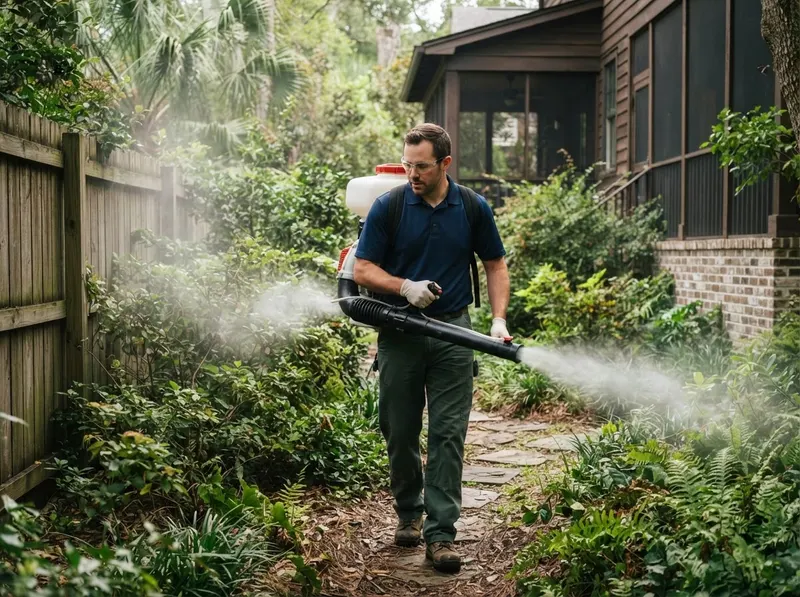
ULV backpack fogging disperses microscopic synthetic pyrethroid and biological growth regulator droplets measured between 15 and 30 microns. These microscopic droplets penetrate dense coastal foliage rather than rolling off leaf cuticles, binding to the undersides of leaves where adult mosquitoes escape midday solar heat. If an owner manages an active short-term rental in Hampton Park Terrace or a waterfront residence on James Island, a high-volume barrier fog provides 21 to 28 days of mechanical knockdown, compared to automated misting systems that require high installation costs and continuous fluid refills. The trade-off centers on duration versus precision: directed fogging requires repeated applications every 3 to 4 weeks during peak wet periods, yet it avoids indiscriminate chemical drift into non-target pollinator beds and marine waterways.
Execution follows an objective three-step methodology. First, technicians inspect the parcel boundary to map critical resting zones, checking beneath elevated porches, behind air-conditioning condensers, and under dense wax myrtle hedges. Second, application teams treat French drains, rain barrels, and catch basins using microbial Bacillus thuringiensis israelensis (BTI) larvicide ring briquettes, eliminating larvae before metamorphosis occurs. Third, applicators lay down a 10-foot-high vertical botanical and micro-encapsulated synthetic mist line along boundary foliage, establishing a continuous structural envelope that neutralizes incoming migratory swarms before they reach patios, docks, or exterior doors.
Every job gets a firm, written price after a free on-site visit.
Tell us about your mosquito reduction fogging job in Charleston and we'll send a clear, written quote, usually the same day.
 PestDefender Pro