Roof rat mechanical exclusion serves as a permanent physical defense rather than a temporary population reduction measure. Standard toxicant bait stations and interior snap traps remove individual animals inside living…
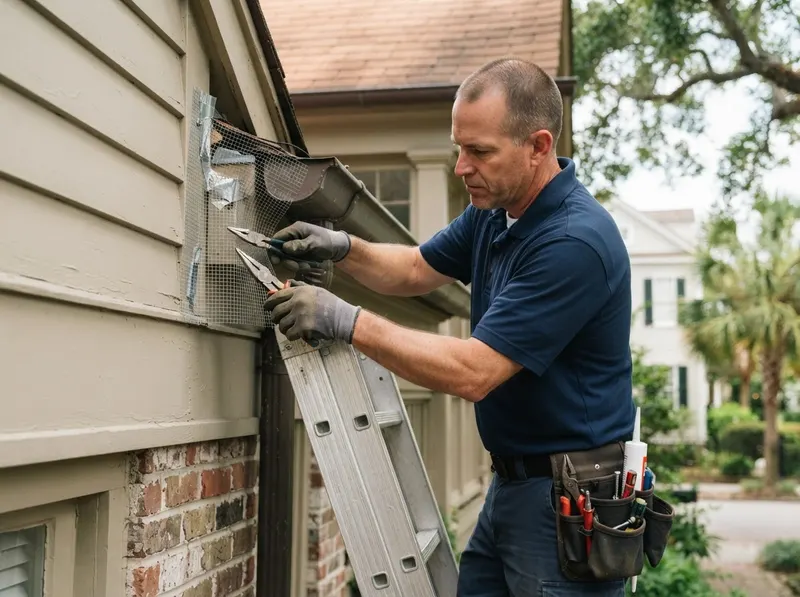
Roof rat mechanical exclusion serves as a permanent physical defense rather than a temporary population reduction measure. Standard toxicant bait stations and interior snap traps remove individual animals inside living areas, but unsealed structures remain continuously vulnerable to recurring harborages through natural aerial pathways. In coastal environments, Rattus rattus exploits tree canopies, Spanish moss hanging from live oaks, and overhead utility drops to navigate directly onto upper structural elements. Utilizing mechanical exclusion seals the structure permanently, eliminating the recurring cycle of chemical applications that fail to address the root building vulnerability.
Historic downtown properties in South of Broad, the French Quarter, and Harleston Village present complex exclusion requirements. Multi-layer slate roofs, historic heart-pine fascia boards, and brick-to-soffit transitions contain small masonry separations that settle over centuries. A mature roof rat requires an opening of only 0.5 inches, the diameter of a standard dime, to compress its skeleton and access attic insulation. In mid-century and modern framing across Wagener Terrace, Hampton Park Terrace, West Ashley, James Island, and Daniel Island, vulnerabilities shift toward unmeshed ridge vents, AC chase penetrations, and loose aluminum soffit returns. Salt air and high relative humidity rapidly corrode cheap wire screens, making standard consumer-grade materials inadequate for coastal building longevity.
Executing exclusion requires 19-gauge 1/4-inch hot-dipped galvanized steel mesh anchored with heavy-duty structural fasteners. Step-flashing joints along dormers are matched with corrosion-resistant galvalume sheet metal to prevent gnawing through wood trim. Expanding foam insulation is never utilized as a standalone barrier, as rodents chew through polyurethane within hours unless reinforced with embedded copper wire cloth. The physical installation seals attic interiors from exterior humidity and nesting materials, preserving blown-in cellulose and fiberglass thermal batts from structural contamination.
Every job gets a firm, written price after a free on-site visit.
Tell us about your roof rat mechanical exclusion job in Charleston and we'll send a clear, written quote, usually the same day.
 PestDefender Pro